

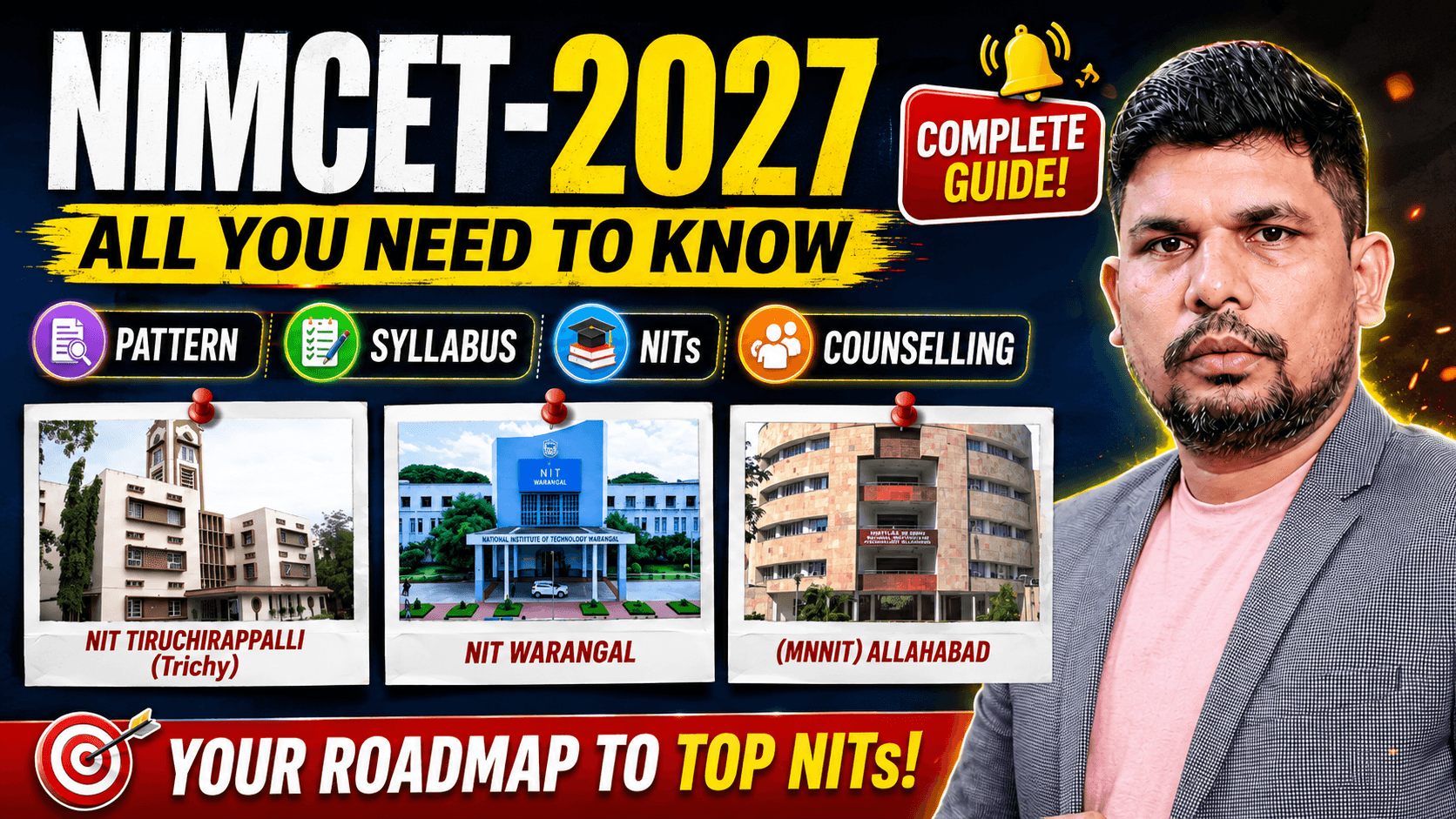

If you're a BCA, B.Sc., or engineering graduate planning to pursue an MCA from a top NIT or IIIT, NIMCET 2027 is very likely on your radar already. It's the single national-level test that decides admission into the MCA programme at 11 NITs and 2 IIITs — and getting a clear, accurate picture of it early makes preparation far less stressful later.
This guide walks you through everything a NIMCET 2027 aspirant needs: what the exam is, who can apply, how it's structured, what's tested, when things happen, which colleges accept it, how rank and counselling work, and how to prepare — all explained in plain language and backed by the latest official NIMCET information.
A quick, important note before we begin: the official NIMCET 2027 information brochure has not been released yet at the time of writing. Wherever this article uses 2027-specific figures — dates, fees, or minor rule details — it is based on the latest official NIMCET brochure available (NIMCET-2026), clearly labelled as such. We'll update this article the moment the NIMCET 2027 brochure goes live on the official website.
Watch the Video Guide: We have explained this NIMCET 2027 topic in detail on YouTube. Watch the complete video to understand the concepts and preparation strategy better.
NIMCET 2027 at a Glance
| Particular | Details |
|---|---|
| Exam Name | NIMCET |
| Full Form | NIT MCA Common Entrance Test |
| Level | National |
| Purpose | Admission to Master of Computer Applications (MCA) programme |
| Conducting Authority | Coordinated by a participating NIT on rotation (NIT Tiruchirappalli coordinated NIMCET-2026) — 2027 coordinator: official information awaited |
| Mode | Online — Computer-Based Test (CBT) (based on latest official information) |
| Duration | 2 hours, in 3 timed parts (based on latest official information) |
| Total Questions | 120 MCQs (based on latest official information) |
| Total Marks | 1,000 (based on latest official information) |
| Major Subjects | Mathematics, Analytical Ability & Logical Reasoning, Computer Awareness, General English |
| Participating Institutes | 11 NITs + 2 IIITs (based on latest official information; subject to confirmation for 2027) |
| NIMCET 2027 Notification | To Be Announced |
| Official Website | nimcet.admissions.nic.in |
What is NIMCET 2027?
NIMCET stands for the NIT MCA Common Entrance Test — a national-level, computer-based entrance exam conducted for admission to the Master of Computer Applications (MCA) programme at India's National Institutes of Technology and select Indian Institutes of Information Technology.
Rather than each institute running its own admission test, NIMCET works as a single common gateway. One application, one exam, one rank — and that rank decides which participating institute you can get into through centralized counselling.
Here's the admission journey in one line:
NIMCET Exam → Rank → Counselling → Choice Filling → Seat Allotment → MCA Admission
Each year, one of the participating NITs coordinates the exam on behalf of all institutes (NIT Tiruchirappalli coordinated the NIMCET-2026 cycle). Which institute will coordinate NIMCET 2027 has not yet been officially announced.
Why is NIMCET Important for MCA Aspirants?
For students aiming at a strong, government-funded MCA programme, NIMCET matters for a few concrete reasons:
- Access to centrally funded institutes. NITs and IIITs are institutes of national importance, and admission through NIMCET opens the door to their MCA programmes.
- A single national-level merit list. You compete against candidates from across the country on one common exam, rather than filling out separate applications for each institute.
- A centralised, standardised process. One registration, one test, one counselling system — this significantly simplifies what would otherwise be a fragmented admission process.
- Structured, industry-aware curriculum. MCA syllabi at NITs/IIITs are designed with current IT-industry requirements in mind.
To keep this guide trustworthy, we're deliberately avoiding vague, unverifiable claims like "100% placement" or "guaranteed job" — these depend on the institute, batch, and market conditions, not the entrance exam itself.
NIMCET 2027 Exam Highlights
| Feature | Details |
|---|---|
| Exam Name | NIMCET |
| Full Form | NIT MCA Common Entrance Test |
| Conducting Authority | Rotating NIT coordinator (2027: awaited) |
| Exam Level | National |
| Purpose | MCA admission at participating NITs/IIITs |
| Mode | Online (Computer-Based Test) |
| Duration | 2 hours (120 minutes), across 3 sequential timed parts |
| Number of Questions | 120 MCQs, 4 options each |
| Maximum Marks | 1,000 |
| Subjects | Mathematics, Analytical Ability & Logical Reasoning, Computer Awareness, General English |
| Negative Marking | Yes — 25% of that question's marks deducted for a wrong answer |
| Participating Institutes | 11 NITs + 2 IIITs (13 institutes total) |
(All figures above are based on the latest official NIMCET-2026 Information Brochure. Please verify against the NIMCET 2027 brochure once it is released.)
NIMCET 2027 Eligibility Criteria
Eligibility is one of the first things every aspirant needs to nail down — and it's also one of the most misunderstood parts of NIMCET. Here's what the latest official rules (NIMCET-2026 brochure) state, which candidates should treat as the reference point until the 2027 brochure confirms otherwise.
Educational Qualification
To appear for NIMCET, a candidate must have completed (or be completing) one of the following:
- Any undergraduate programme of at least 3 years' duration, with Mathematics or Statistics as one of the subjects, OR
- A B.E./B.Tech. degree from a recognized university/institution (in any stream).
The Mathematics Requirement
This is the query that trips up the most students. If your UG degree is not an engineering degree (B.E./B.Tech.), you must have studied Mathematics or Statistics as a subject at some point during your degree. A B.Sc. Computer Science degree, for instance, is eligible only if Mathematics/Statistics was actually part of the curriculum as a paper — not simply because the subject is "computing-related." Always check your own transcript/syllabus carefully rather than assuming.
Minimum Marks Required
- 60% aggregate marks or 6.5 CGPA (on a 10-point scale) for General/OBC/EWS candidates.
- 55% aggregate marks or 6.0 CGPA for SC/ST/PwD candidates.
- Percentage/CGPA is calculated using marks from all subjects across all years of the degree — including languages and electives, not just the major subjects.
- Conversion between CGPA and percentage (or vice versa) is not permitted directly; a non-10-point CGPA is converted using the unitary method.
Can Final-Year Students Apply?
Yes. Candidates who are in their final year or awaiting results are eligible to apply, provided they submit proof of candidature (typically a certificate from the head of their institution). Proof of having actually met the eligibility criteria must be submitted by the deadline specified in the official brochure — missing this can lead to cancellation of admission even after a seat has been allotted.
Nationality
NIMCET eligibility is limited to Indian Nationals.
Age Limit
There is no officially stated age limit in the latest available NIMCET brochure.
Who is Eligible for NIMCET? — Quick Examples
| Background | Eligibility Status |
|---|---|
| BCA with Mathematics/Statistics as a subject | Eligible, subject to meeting the % / CGPA cutoff |
| B.Sc. Mathematics / B.Sc. (Hons.) Mathematics | Eligible, subject to meeting the % / CGPA cutoff |
| B.Sc. Computer Science without Mathematics/Statistics as a subject | Not eligible under the subject-requirement route — verify your degree structure carefully |
| B.E. / B.Tech. (any stream) | Eligible via the engineering-degree route, subject to meeting the cutoff |
| Final-year student awaiting results | Eligible to apply, with proof of candidature; eligibility proof due by the brochure-specified date |
Always verify your specific eligibility against the official NIMCET 2027 brochure before applying — universities and degree structures vary, and rules can be revised year to year.
NIMCET 2027 Exam Pattern
The exam is conducted as a single online paper split into three sequential, individually timed parts. You cannot move back to a completed part once its time is up, and you cannot borrow time from a later part.
| Part | Subject | Questions | Duration | Marks per Correct Answer | Negative Marking | Max Marks |
|---|---|---|---|---|---|---|
| Part I | Mathematics | 50 | 70 minutes | 12 | 3 | 600 |
| Part II | Analytical Ability & Logical Reasoning | 40 | 30 minutes | 6 | 1.5 | 240 |
| Part III | Computer Awareness | 20 | 20 minutes (shared with English) | 6 | 1.5 | 120 |
| Part III | General English | 10 | 20 minutes (shared with Computer Awareness) | 4 | 1 | 40 |
| Total | — | 120 | 120 minutes (2 hours) | — | — | 1,000 |
Key points to note about the pattern:
- All questions are multiple-choice, with four options each, and appear in English only.
- The three parts appear one after another on screen. Time allotted per part is fixed and non-transferable.
- Mathematics alone accounts for 60% of the total marks (600/1000) — making it, by far, the most important section to master.
(Pattern based on the latest official NIMCET-2026 Information Brochure. NIMCET 2027 pattern will be confirmed once the official notification is released.)
NIMCET 2027 Marking Scheme
Understanding the marking scheme is essential for exam-day strategy, given how significant the negative marking is.
- Correct Answer: Full marks for that question (12 / 6 / 6 / 4, depending on the section).
- Incorrect Answer: A 25% negative deduction of that question's marks.
- Unattempted Question:No deduction — you lose nothing by leaving a question blank.
Example: In Mathematics, a correct answer earns +12 marks, while a wrong answer costs −3 marks (25% of 12). Leaving the question unattempted costs 0.
Qualifying condition: A candidate scoring zero or negative marks either in Mathematics or in the total score is disqualified from the rank list — regardless of performance elsewhere.
Because of this structure, accuracy matters just as much as speed. Guessing without reasonable elimination can do more harm than good.
NIMCET 2027 Syllabus
The NIMCET syllabus is divided into four sections, weighted very unevenly — which should directly shape how you allocate preparation time.
Mathematics (50 Questions, 600 Marks)
- Set Theory & Logic: Sets, unions, intersections, Cartesian products, functions & relations, Venn diagrams, truth tables, tautologies and contradictions.
- Probability & Statistics: Basic probability, dependent/independent events, Bayes' theorem, mean, median, mode, standard deviation, variance, and frequency distributions.
- Algebra: Quadratic equations, relations between roots and coefficients, indices, logarithms, progressions (AP/GP/HP), matrices & determinants, simultaneous linear equations, permutations & combinations, and the binomial theorem.
- Coordinate Geometry: Straight lines, pairs of lines, circles, parabola, ellipse, hyperbola, and tangents/normals to conics.
- Calculus: Limits, continuity, differentiation and its applications, maxima/minima, Rolle's theorem, Mean Value Theorem, and integration (by parts, substitution, partial fractions, definite integrals, area computation).
- Trigonometry: Trigonometric identities, inverse trigonometric functions, properties and solutions of triangles, heights & distances, and trigonometric equations.
Analytical Ability & Logical Reasoning (40 Questions, 240 Marks)
- Verbal & Non-Verbal Reasoning: Blood relations, coding-decoding, direction tests, seating arrangements, mirror images.
- Deductive & Inductive Reasoning: Puzzles, input-output, syllogism, alphanumeric series, statements and conclusions/arguments.
- Problem Solving & Data Skills: Critical thinking, data interpretation, numerical reasoning, data sufficiency, and data visualization.
Computer Awareness (20 Questions, 120 Marks)
- Computer Fundamentals: CPU organization, instruction structure, input/output devices, memory and back-up devices.
- Data Representation: Character/integer/fraction representation, binary & hexadecimal systems, binary arithmetic, and Boolean algebra.
- Hardware: Input devices, output devices, storage devices, RAM/ROM/cache.
- Software & Operating Systems: OS basics (Windows, macOS, Linux, Android), utility programs, device drivers, and application software.
- Internet & Networking: Web browsing fundamentals, email usage, and basic online-security awareness.
General English (10 Questions, 40 Marks)
- Comprehension of written text
- Vocabulary usage
- Grammatical patterns and sentence forms
- Meaning of words and phrases
- Technical writing basics
- Overall accuracy and fluency of expression
Note: This syllabus reflects the latest official NIMCET-2026 brochure. It's a good working reference, but confirm against the official NIMCET 2027 syllabus once released — minor revisions are possible.
[NIMCET 2027 Syllabus PDF — Download]
NIMCET 2027 Important Dates
Since the NIMCET 2027 brochure has not been released, none of the dates below are confirmed for 2027. The table shows the NIMCET-2026 schedule as a reference point, alongside an "expected" window based on the typical annual cycle.
| Event | NIMCET-2026 Date (Reference) | NIMCET 2027 Status |
|---|---|---|
| Notification | 2 March 2026 | To Be Announced — Expected around Feb–Mar 2027 |
| Registration Opens | 3 March 2026 | To Be Announced |
| Last Date to Apply | 1 May 2026 | To Be Announced |
| Application Correction/Edit Window | 5–7 May 2026 | To Be Announced |
| Admit Card Availability | 27 May – 6 June 2026 | To Be Announced |
| Examination Date | 6 June 2026 | To Be Announced — Expected around June 2027 |
| Answer Key Challenge Window | 10–11 June 2026 | To Be Announced |
| Result / Rank Declaration | 29 June 2026 (tentative) | To Be Announced |
| Counselling Registration & Choice Filling | 30 June – 3 July 2026 | To Be Announced |
| First Round of Seat Allotment | 6 July 2026 | To Be Announced |
| Second Round of Seat Allotment | 11 July 2026 | To Be Announced |
| Third Round of Seat Allotment | 16 July 2026 | To Be Announced |
| Special Round (Vacant Seats) | 22–25 July 2026 | To Be Announced |
The takeaway: based on the last few cycles, NIMCET typically follows a notification (Feb–Mar) → exam (June) → result (late June) → counselling (July) rhythm. Treat the 2026 dates above purely as an indicative pattern — never as confirmed 2027 dates.
NIMCET 2027 Participating Institutes
Based on the latest official information (NIMCET-2026), the following 11 NITs and 2 IIITs participate in the NIMCET admission process. The exact list for NIMCET 2027 will be confirmed only in the official 2027 brochure — the list of participating institutes can occasionally change between cycles.
Participating NITs (11)
- NIT Agartala
- Motilal Nehru NIT (MNNIT) Allahabad
- Maulana Azad NIT (MANIT) Bhopal
- NIT Delhi
- NIT Jamshedpur
- NIT Kurukshetra
- NIT Meghalaya
- NIT Patna
- NIT Raipur
- NIT Tiruchirappalli (Trichy)
- NIT Warangal
Participating IIITs (2)
- IIIT Bhopal
- IIIT Vadodara (Gandhinagar and Diu campuses)
Together, these 13 institutes offered a total of 1,300 MCA seats in the NIMCET-2026 cycle, across Open, OBC, SC, ST, EWS and PwD categories, with no separate state-wise quota. Some institutes (e.g., NIT Delhi, NIT Kurukshetra, NIT Patna) also run additional self-financing seats alongside the regular quota, typically at a higher fee.
[NIMCET Participating Institutes — Seat Matrix & Fee Details]
Best NIMCET Colleges / NITs
A common question every aspirant asks is: "Which NIT should I actually target?" While NIMCET does not publish any official institute "tier" or ranking, students commonly group institutes informally using factors such as historical closing ranks, academic reputation, placement trends, location, and alumni strength.
For guidance purposes only, institutes are often informally discussed in three broad preference bands:
- Most preferred / highly competitive: Institutes that have historically closed at the strongest (lowest numerical) ranks.
- Strong, well-established options: Institutes with solid reputation and consistent demand.
- Good backup/safe choices: Institutes offering a good academic environment with comparatively more accessible closing ranks.
Important: This is an indicative preference framework based on publicly available historical information and student sentiment — it is NOT an official NIMCET classification or ranking. Every student's ideal choice depends on personal priorities: location, fee structure, specialization interest, and career goals, not rank alone.
NIMCET 2027 Cutoff and Rank
Before diving into rank strategy, it helps to be clear on the terminology:
- Marks: The raw score you obtain out of 1,000 in the NIMCET exam.
- Rank: Your position in the merit list, computed from your total marks (with tie-breakers applied where needed).
- Opening Rank: The best (numerically lowest) rank at which a seat was allotted in a given institute/category/round.
- Closing Rank: The last (numerically highest) rank at which a seat was allotted in that same institute/category/round — commonly called the "cutoff."
- Category: Closing ranks differ sharply across OC, OBC, SC, ST, EWS and PwD categories — always compare within your own category.
- Counselling Round: Closing ranks generally loosen (increase) in later rounds as higher-rank candidates float, freeze, or withdraw.
Cutoffs are not fixed values — they shift every year based on the number of applicants, seat availability, and how candidates behave during counselling (float/freeze/withdraw decisions).
Tie-breaker rule: If two or more candidates score identical total marks, NIMCET breaks the tie using, in order: (1) higher marks in Mathematics, (2) higher marks in Analytical Ability & Logical Reasoning, (3) higher marks in Computer Awareness, (4) higher age, and finally (5) random computer-based selection.
Previous Year NIMCET Cutoff
NIMCET does not publish one single common cutoff list. Instead, each participating NIT/IIIT determines its own opening and closing ranks independently, based on the choices filled by candidates and seat availability in that round.
To avoid presenting inaccurate, outdated, or misleading figures, we have intentionally not reproduced specific institute-wise opening/closing rank numbers in this article. For the most accurate and current picture:
- Check the official round-wise seat allotment results on the NIMCET counselling portal.
- Compare trends across the last 2–3 years, not a single year, to judge how stable a rank range is.
- Always match your own category precisely — cutoffs vary sharply by category.
- Note the round number — Round 1 cutoffs are typically tighter than later rounds or the special round.
Previous-year cutoffs are useful for estimating competition, but they do not guarantee admission in 2027.
[NIMCET Previous Year Question Papers & Cutoff Trends]
NIMCET 2027 Selection Process
The complete journey from application to admission follows these steps:
- Registration — Create an account using a personal email ID and mobile number.
- Application Submission — Fill in personal, academic, and category details; upload required documents; pay the application fee.
- Admit Card — Download from the official website within the specified window.
- Entrance Examination — Appear for the online, three-part CBT at your allotted test centre.
- Result Declaration — Check your score and rank on the official website.
- Rank Card — Download your official rank card; no physical copy is sent.
- Counselling Registration & Choice Filling — Qualified candidates register for counselling and fill institute/programme choices online, paying the counselling registration fee.
- Choice Locking — Choices are locked automatically at the deadline specified in the counselling schedule.
- Seat Allotment — Seats are allotted round-wise, based on rank and the choices filled.
- Seat Acceptance / Float / Freeze / Withdrawal — After each round, candidates pay the seat acceptance fee and decide whether to float to the next round, freeze their seat, or withdraw.
- Document Verification — Submit original documents as per the schedule of the allotted institute.
- Final Admission — Report to the allotted institute and complete admission formalities.
NIMCET 2027 Counselling Process
Counselling is where your rank actually translates into a seat — and it deserves as much attention as exam preparation itself.
- Counselling Registration: A separate, paid registration step after the result is declared (typically a non-refundable fee, e.g., ₹1,000 in the 2026 cycle).
- Choice Filling: Candidates arrange participating institutes/programmes in order of preference.
- Choice Locking: Choices are automatically locked at a fixed deadline — after locking, no further edits are possible.
- Seat Allotment: Conducted round-wise (typically three general rounds), strictly based on rank and filled choices.
- Seat Acceptance: On being allotted a seat, candidates pay a seat acceptance fee (e.g., ₹10,000 in the 2026 cycle) to confirm interest.
- Float / Freeze / Withdraw:
- Float — Stay in the running for a better allotment in the next round.
- Freeze — Lock in the current allotment and pay the partial admission fee.
- Withdraw — Exit the counselling process entirely.
- Special Round: After the general rounds, any vacant seats are opened for fresh choice filling in a special round.
- Document Verification & Reporting: Final, in-person reporting and document verification at the allotted institute completes the admission.
This process (and the exact fee amounts) is based on the NIMCET-2026 cycle. Always cross-check against the official "User Guidelines for E-Counselling" document once released for NIMCET 2027.
How to Fill NIMCET College Choices?
Choice filling is a strategic exercise, not a formality. A commonly used approach is to split your preference list into three bands:
Dream Choices
Institutes you'd genuinely love to attend, even if your rank makes them a stretch based on recent trends.
Realistic Choices
Institutes where your rank comfortably fits within recent closing-rank trends for your category.
Safe Choices
Institutes where your rank is very likely to secure a seat — this reduces the risk of ending the counselling process with no allotment at all.
When ordering your final list, weigh:
- Previous closing ranks (for your category)
- Personal preference and career goals
- Location and connectivity
- Fee structure (regular vs. self-financing seats)
- Academic environment and placement trends
Avoid blindly copying another student's choice order — your rank, financial situation, and priorities are your own, and a choice order that works well for someone else may not serve you at all.
NIMCET 2027 Preparation Strategy
Here's a practical, step-by-step approach rather than generic motivation:
Step 1 — Understand the syllabus thoroughly. Before opening a single book, read through the official syllabus so you know exactly what's in scope (and what isn't).
Step 2 — Build mathematical fundamentals. Since Mathematics carries 60% of the total marks, prioritize concept clarity here over rote practice — especially in Algebra, Calculus, and Coordinate Geometry.
Step 3 — Practice reasoning regularly. Analytical Ability & Logical Reasoning rewards consistent, short daily practice more than long, irregular study sessions.
Step 4 — Strengthen computer awareness. This section is high-yield relative to its size — concepts like number systems, data representation, and OS basics are usually straightforward to master quickly.
Step 5 — Improve English steadily. With only 10 questions, don't over-invest time here, but don't neglect it either — targeted vocabulary and grammar practice goes a long way.
Step 6 — Solve previous-year questions (PYQs). PYQs reveal the actual difficulty level and question style far better than any predicted pattern.
Step 7 — Take sectional tests. Test one section at a time to identify specific weak areas before attempting full mocks.
Step 8 — Take full-length mock tests. Simulate the exact three-part, time-boxed structure — including the strict, non-transferable timing per part.
Step 9 — Analyze every mistake. A mock test is only useful if you review why each error happened — concept gap, calculation slip, or time pressure.
Step 10 — Improve speed and accuracy together. Given the 25% negative marking, work on recognizing which questions to attempt confidently and which to skip — speed without accuracy can actively hurt your score.
[Internal Link: NIMCET Mock Test Series by Crackora] [Internal Link: NIMCET Preparation Course] [Internal Link: NIMCET eBooks & Study Material]
Common Mistakes NIMCET Aspirants Should Avoid
- Starting preparation without reading the syllabus first — leads to wasted effort on out-of-scope topics.
- Ignoring Mathematics — given its 60% weightage, this is the costliest mistake an aspirant can make.
- Only studying theory, never practicing questions — NIMCET rewards applied problem-solving speed, not just conceptual knowledge.
- Not solving previous-year questions — missing out on real insight into difficulty and question patterns.
- Taking mocks without analyzing them — a mock test without a review session teaches you very little.
- Underestimating negative marking — careless guessing can undo the benefit of several correct answers.
- Poor time management within sections — since each part has a fixed, non-transferable timer, poor pacing in one part cannot be compensated for in another.
- Not tracking recurring mistakes — the same conceptual gaps often show up repeatedly if not addressed directly.
- Delaying preparation until the last few months — Mathematics especially needs sustained, spaced-out practice.
- Relying on unverified information — always cross-check dates, eligibility, and syllabus against the official NIMCET website rather than social media or forwarded messages.
Frequently Asked Questions About NIMCET 2027
1. What is NIMCET 2027? NIMCET 2027 is the upcoming edition of the NIT MCA Common Entrance Test, a national-level exam for admission to the MCA programme at participating NITs and IIITs. The official 2027 notification has not yet been released.
2. Who can apply for NIMCET? Indian nationals who have completed (or are completing) a 3-year UG degree with Mathematics/Statistics as a subject, or a B.E./B.Tech. degree, meeting the prescribed percentage/CGPA cutoff, are eligible to apply.
3. Is BCA eligible for NIMCET? Yes, provided Mathematics or Statistics was studied as a subject during the BCA programme and the candidate meets the minimum marks/CGPA requirement.
4. Is Mathematics compulsory for NIMCET eligibility? Yes, unless the candidate holds a B.E./B.Tech. degree. For non-engineering UG degrees, Mathematics or Statistics must have been studied as a subject.
5. What is the NIMCET 2027 syllabus? The syllabus (based on the latest official information) covers Mathematics, Analytical Ability & Logical Reasoning, Computer Awareness, and General English. See the detailed breakdown above.
6. What is the NIMCET exam pattern? 120 MCQs across three timed parts — Mathematics (50Q), Analytical Ability & Logical Reasoning (40Q), and Computer Awareness + General English (30Q combined) — for a total of 1,000 marks, based on the latest official information.
7. Is there negative marking in NIMCET? Yes. A wrong answer results in a 25% negative deduction of that question's marks. There is no penalty for unattempted questions.
8. How many NITs participate in NIMCET? Based on the latest official information, 11 NITs participate, along with 2 IIITs — 13 institutes in total.
9. Which colleges accept NIMCET scores? The 11 participating NITs (Agartala, Allahabad, Bhopal, Delhi, Jamshedpur, Kurukshetra, Meghalaya, Patna, Raipur, Tiruchirappalli, Warangal) and 2 IIITs (Bhopal, Vadodara) accept NIMCET rank for MCA admission.
10. What is a good NIMCET rank? This depends heavily on your target institute, category, and the year's competition level. There is no single "good rank" — always compare against recent historical trends for your specific category and institute.
11. How does NIMCET counselling work? After results, qualified candidates register for counselling, fill institute choices, and receive seat allotments round-wise based on rank. Candidates can float, freeze, or withdraw after each round, with a special round for vacant seats at the end.
12. Is there an age limit for NIMCET? No age limit is specified in the latest available official brochure.
13. Can final-year students apply for NIMCET 2027? Yes, final-year or result-awaited candidates can apply, provided they submit proof of candidature and later furnish proof of eligibility by the deadline specified in the brochure.
14. When will NIMCET 2027 registration start? This has not been officially announced. Based on the previous cycle, registration is expected to open around February–March 2027 — but this is an estimate, not a confirmed date.
15. How should I prepare for NIMCET 2027? Start with the syllabus, build strong Mathematics fundamentals, practice reasoning and computer awareness regularly, solve previous-year papers, and take timed full-length mocks with proper analysis. See the preparation strategy section above for a step-by-step approach.
Final Verdict: Getting Ready for NIMCET 2027
NIMCET 2027 is a national-level opportunity worth preparing for seriously — but success starts with clarity, not assumptions. Before you dive into preparation:
- Check your eligibility carefully, especially the Mathematics/Statistics requirement if you're not from an engineering background.
- Understand the latest syllabus and exam pattern in detail, rather than relying on secondhand summaries.
- Follow the official notification closely once it's released — don't build your preparation timeline around assumed dates.
- Start early, particularly for Mathematics, which carries the largest share of marks.
- Practice previous-year questions and take full-length mocks under exam-like time constraints.
- Target a realistic rank range based on your category and preferred institutes, and approach counselling with a well-thought-out choice list — not guesswork.
- Understand the counselling process before results are out, so you're not making rushed decisions during a tight allotment window.
Clarity Before Confidence — start your NIMCET 2027 preparation with Crackora.
Fact-Check Summary
Officially Confirmed for NIMCET 2027:
- None at the time of writing. The official NIMCET 2027 notification/brochure has not been released.
Based on Latest Official Information (NIMCET-2026 Brochure):
- Exam pattern (120 MCQs, 3 parts, 1,000 marks)
- Marking scheme (25% negative marking, no penalty for unattempted)
- Eligibility criteria (60%/6.5 CGPA general; 55%/6.0 CGPA SC/ST/PwD; Mathematics/Statistics or B.E./B.Tech. route)
- Syllabus (Mathematics, Analytical Ability & Logical Reasoning, Computer Awareness, General English)
- Participating institutes (11 NITs + 2 IIITs)
- Counselling process structure (registration, choice filling, locking, round-wise allotment, float/freeze/withdraw, special round)
- Fee structure references (application fee, counselling fee, seat acceptance fee)
Expected/Tentative for NIMCET 2027:
- Notification timing (estimated Feb–Mar 2027, based on the 2026 cycle)
- Exam date (estimated around June 2027)
- Overall annual admission cycle rhythm
Historical Information (NIMCET-2026, for reference only):
- All specific 2026 dates (notification, application window, exam date, result date, counselling rounds)
- 2026 seat matrix (1,300 total seats) and fee structure figures
Information Awaited:
- NIMCET 2027 notification date
- NIMCET 2027 application window
- NIMCET 2027 exam date
- NIMCET 2027 coordinating institute
- Any changes to eligibility, syllabus, exam pattern, fees, or participating institutes for 2027
- NIMCET 2027 opening/closing ranks (not available until after the 2027 counselling cycle)